
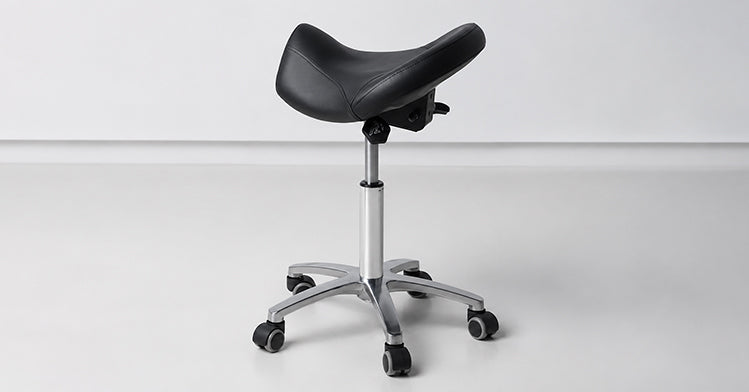
US estheticians spend four to eight hours per day in a seated forward-lean position performing facial treatments, waxing, and skin care procedures. A saddle stool reduces the lumbar and neck load that accumulates in this position, provides the mobility needed to move around a treatment table freely, and keeps energy levels higher across a full treatment day. This guide covers what to look for when choosing one. This content is for informational purposes only and does not constitute medical advice.
Why Do US Estheticians Need an Ergonomic Saddle Stool?
US estheticians perform highly repetitive, precision-focused work in a sustained seated forward-lean position. Unlike many seated professionals, estheticians must also maintain consistent reach, steady hands, and visual focus simultaneously, all while seated. The combination of static load and fine motor precision makes seating quality directly relevant to treatment quality.
According to the National Institute for Occupational Safety and Health (NIOSH), prolonged awkward seated posture is a primary risk factor for work-related musculoskeletal disorders (MSDs) across all healthcare and personal care occupations, which includes esthetics. US estheticians who spend full days in a forward-lean seated position without ergonomic correction accumulate significant cumulative spinal load across their careers.
ProNorth Medical supplies saddle stools that give US estheticians the posture correction, comfort, and mobility needed for a full treatment day.
How Does a Saddle Stool Improve an Esthetician's Working Position?
A saddle stool improves an esthetician's working position by opening the hip angle from the 90 degrees typical of flat-seat stools to approximately 135 degrees. This forward pelvic tilt restores the lumbar spine's natural curve, reduces compression at the lower back, and allows the trunk to remain upright without muscular effort.
In this corrected seated position, an esthetician performing a facial treatment can lean forward from the hips rather than rounding from the lower back. The reach to the client’s face is supported by the body’s natural balance rather than by sustained muscular contraction against gravity. The result is less end-of-day back and neck fatigue, and better sustained concentration during treatments.
For more on how saddle stool geometry corrects seated posture, read ProNorth Medical's content on saddle stool posture for professionals who perform extended seated work.
What Features Should a US Esthetician Look for in a Saddle Stool?
For US estheticians, the five most important saddle stool features are height adjustability, seat cushioning, mobility, upholstery material, and weight capacity.
- Height adjustability: An esthetician's stool height needs to match the treatment table height so the operator can reach the client's face and neck without shoulder elevation or excessive forward lean. A height range of 18 to 28 inches covers most US esthetics table configurations.
- Seat cushioning: Dual-layer foam construction with a memory foam or polyurethane top layer provides the sustained comfort needed for four to eight hour treatment days. Single-layer foam compresses over time and reduces its ergonomic benefit.
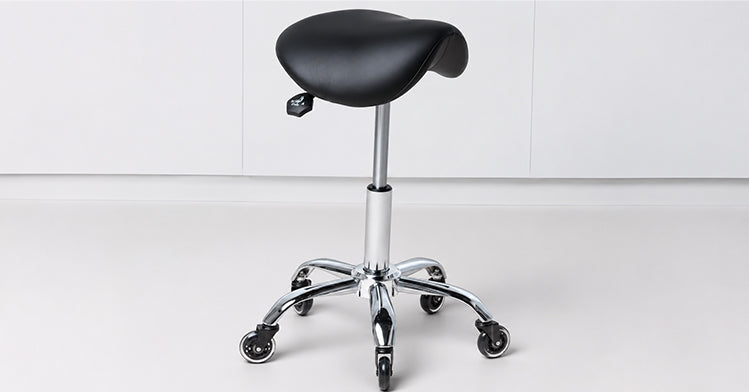
- Mobility: Dual-wheel castors on a five-point base give the esthetician the ability to glide around the treatment table without lifting or walking the stool, which is important for maintaining position during facial and body treatments.
- Upholstery: PU vinyl upholstery is the standard for esthetics environments because it is fluid-resistant, easy to sanitize between clients, and does not retain skin care product residue in surface texture.
- Weight capacity: A dynamic weight rating of at least 265 pounds accommodates the full range of US estheticians and the forces generated by shifting and repositioning during treatments.
ProNorth Medical's ergonomic seating options meet all of these specifications for US esthetics professionals.
How Does a Saddle Stool Compare to a Standard Rolling Stool for Esthetics?
|
Feature |
Saddle Stool |
Standard Rolling Stool |
|
Hip Angle |
~135 degrees, lumbar support natural |
~90 degrees, lumbar flattening common |
|
Posture Correction |
Structural, built into seat geometry |
Relies on user effort to maintain |
|
Forward Reach |
Hips forward, spine balanced |
Spine rounds, neck loads forward |
|
Fatigue at End of Day |
Typically lower with correct setup |
Typically higher from static load |
|
Upholstery Standard |
PU vinyl clinical grade |
Varies widely, often not sanitizable |
|
Height Range |
18 to 28+ inches clinical range |
Often limited to 18 to 22 inches |
US estheticians who switch from standard rolling stools to saddle stools consistently report reduced end-of-day fatigue and improved posture awareness during treatments. For guidance on how to set up and adjust a saddle stool correctly for esthetics use, read ProNorth Medical's adjustment guide.
Does Saddle Stool Use Improve Treatment Quality for US Estheticians?
Yes, in a practical sense. An esthetician who is less fatigued in the afternoon has steadier hands, better visual focus, and more consistent technique across a full treatment day. Ergonomic seating reduces the physical attrition that standard stools create, which preserves the precision and attentiveness that high-quality facial and skin care treatments require.
US esthetics clients increasingly notice the professionalism and stability of practitioners who use proper clinical seating, and esthetics studios that invest in ergonomic equipment signal a commitment to both practitioner welfare and treatment quality.
ProNorth Medical supplies saddle stools to US esthetics professionals and beauty studios. Contact the team through contact form to discuss stool models, height specifications, and options suitable for your treatment room setup.
Frequently Asked Questions
1. What is the best saddle stool for a US esthetician?
The best saddle stool for a US esthetician has a height range matching the treatment table (typically 18 to 28 inches), dual-layer foam cushioning for full-day comfort, PU vinyl upholstery for easy sanitation, dual-wheel castors for smooth table-side mobility, and a dynamic weight capacity of at least 265 pounds. ProNorth Medical's saddle stools meet these specifications for US beauty professionals.
2. How does a saddle stool reduce fatigue for estheticians during facial treatments?
A saddle stool reduces fatigue by opening the hip angle to approximately 135 degrees, which restores the lumbar spine's natural curve and removes the static muscle load that accumulates with a 90-degree flat-seat position. The result is less back and neck tension across a treatment day. For more on posture and fatigue, read ProNorth Medical's content on saddle stool posture.
3. Can a US esthetician use a saddle stool for both facial and waxing treatments?
Yes. A saddle stool with a full height range is versatile enough to support both facial treatments and waxing procedures. The height adjustment allows the esthetician to position correctly for different treatment types and client positioning. The mobility of the five-point caster base supports repositioning during body treatments. ProNorth Medical's ergonomic seating catalog includes models suitable for multi-treatment use.
4. How should a US esthetician set up a saddle stool for facial treatments?
Set the stool height so the thighs slope downward at 10 to 20 degrees below horizontal, with feet flat on the floor. Adjust the stool position so the elbows remain close to the sides at approximately 90 degrees during treatment, avoiding shoulder elevation. The head should reach the client's face with a slight natural downward tilt rather than a pronounced forward head position. For full setup guidance, read ProNorth Medical's adjustment guide.
5. Is a saddle stool safe to use in a US esthetics studio?
Yes. A clinical-grade saddle stool with PU vinyl upholstery, a certified gas lift, and a five-point caster base is safe for use in a US esthetics studio environment. The PU vinyl surface can be sanitized between clients, and the certified gas lift handles the daily height adjustments without failure risk. Visit ProNorth Medical for full product certification documentation.
Key Takeaways
- US estheticians spend four to eight hours per day in a sustained forward-lean seated position, making ergonomic seating one of the most impactful investments they can make for career longevity.
- A saddle stool opens the hip angle to approximately 135 degrees, restoring lumbar lordosis and enabling forward reach from the hips rather than through lower back rounding.
- Reduced end-of-day fatigue from saddle stool use directly supports treatment quality by preserving hand steadiness, visual focus, and technique consistency across a full day.
- PU vinyl upholstery is the correct standard for esthetics environments because it is fluid-resistant, sanitizable between clients, and does not retain skin care product residue.
- A height range of 18 to 28 inches covers most US treatment table configurations for facial, waxing, and body treatment procedures.
- Dual-layer foam cushioning with a memory foam or polyurethane top layer provides the sustained comfort needed for full treatment day performance.


Leave a comment
This site is protected by hCaptcha and the hCaptcha Privacy Policy and Terms of Service apply.